

Written by: Trek Investment Committee
Key Takeaways
- Equity markets recovered during the second quarter despite continued geopolitical and policy uncertainty.
- Economic growth slowed but remained positive, an important distinction from an outright contraction.
- The Federal Reserve maintained a patient approach as it balanced slower growth against inflation that remained above target.
- The conflict involving Iran continued to affect energy markets, but investors became more focused on its economic consequences than on each individual headline.
- As we enter the second half of 2026, the central question is whether economic growth and corporate earnings remain resilient enough to support current market expectations.
Markets Looked Beyond the Headlines
The second quarter of 2026 provided an important reminder that markets and headlines rarely move in lockstep. Geopolitical tensions remained elevated, economic growth slowed, and the Federal Reserve maintained a cautious approach to monetary policy. Even so, equity markets recovered strongly from the volatility experienced earlier in the year.
At first glance, that may seem surprising. Some investors may assume that uncertainty is automatically bad for financial markets. In reality, markets are not as focused on uncertainty itself as they are on whether new information changes expectations for corporate earnings, inflation, interest rates, or long-term economic growth.
During the second quarter, investors appeared to conclude that many of the risks dominating daily headlines were less likely to disrupt the broader economy than initially expected. Rather than reacting to every new headline, market adjusted to reflect a lower probability of lasting economic damage.
Markets Began to Differentiate Between Headlines and Fundamentals
The second quarter marked a shift in how investors viewed risk. During the first quarter, markets frequently reacted to the concerns that geopolitical tensions, slowing growth, or persistent inflation could weaken the economy. By the second quarter, investors shifted their focus toward whether those risks were actually likely to affect corporate earnings or the broader economic outlook.
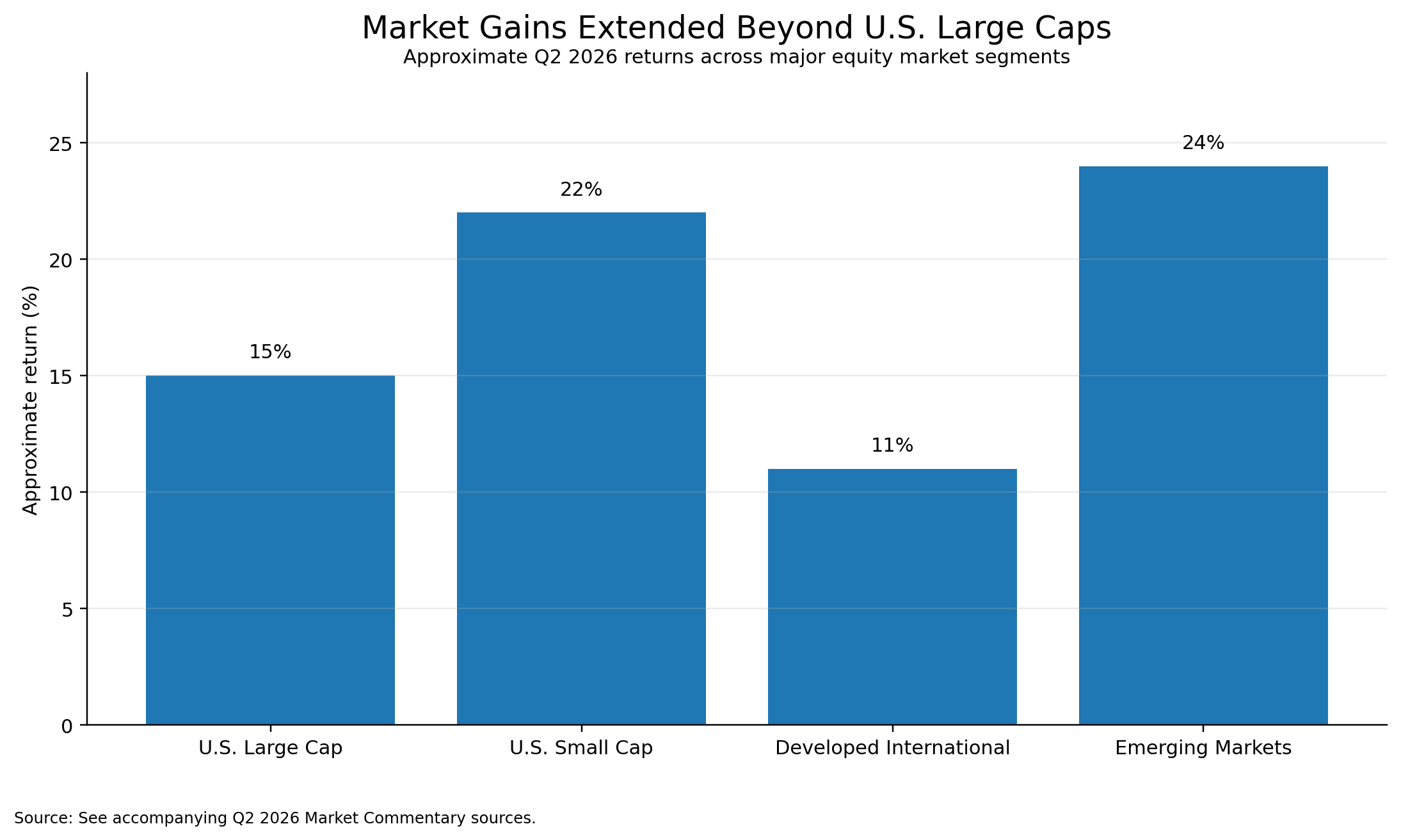
That change was reflected across many areas of the market. U.S. large-cap stocks returned approximately 15% during the quarter, while small-cap stocks gained roughly 22%. Developed international equities advanced nearly 11%, and emerging-market equities returned approximately 24%. The breadth of those gains showed that participation extended well beyond the largest U.S. technology companies.1
Technology and artificial intelligence remained important drivers of performance. Nasdaq reported that the S&P 500 and Nasdaq-100 recorded their strongest quarters since Q2 2020. The Philadelphia Semiconductor Index gained nearly 88%, its best quarter since the index began in 1994. Nasdaq also reported that participation broadened as the quarter progressed, with small-cap, microcap, equal-weighted, and value benchmarks reaching new highs near quarter-end.2
The recovery did not mean that risk disappeared. Instead, investors became more selective about which risks were most likely to have a lasting impact. Geopolitical headlines continued to create periods of volatility, but markets increasingly differentiated between short-term disruptions and developments that could meaningfully affect inflation, energy supplies, economic growth, or corporate profitability.
That improving confidence raises an important question. Did the economic data justify the market’s optimism?
The Economy Continued to Slow, but Not Stall
At first glance, the economic data appeared mixed. Growth slowed, inflation remained above the Federal Reserve’s target, and hiring continued to cool. Taken together, however, the data pointed to an economy transitioning toward a slower pace of expansion rather than one entering recession.
Real gross domestic product (GDP) increased at an annual rate of 1.5% during the second quarter, following 2.1% growth in the first quarter. Consumer spending, business investment, and exports helped drive growth, while lower government spending partially offset those gains. One encouraging sign was that real final sales to private domestic purchasers, a measure combining consumer spending and private fixed investment, increased at an annualized rate of 3.9%. As with all advance GDP estimates, these figures may be revised.3
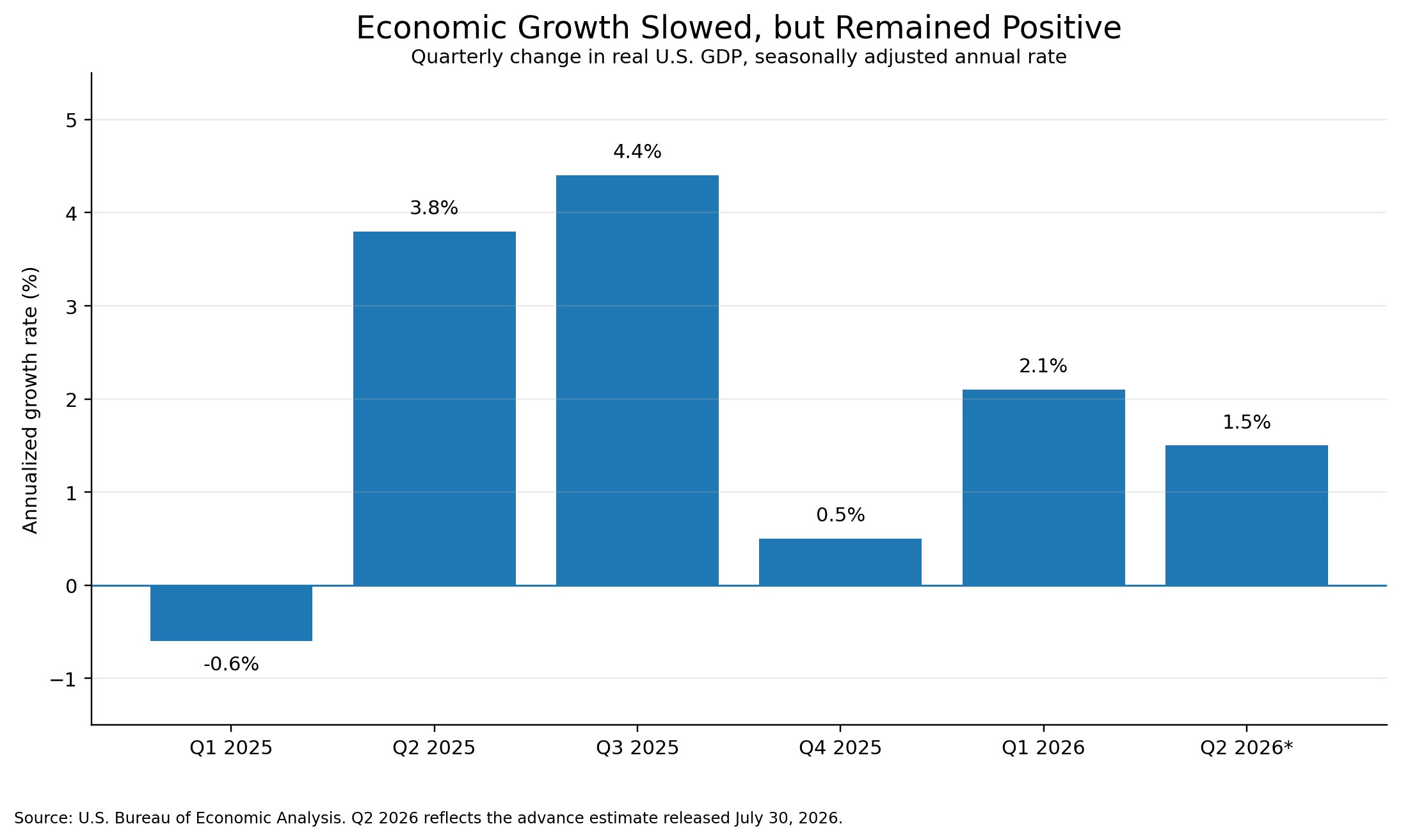
Slower growth is not the same as economic contraction. The GDP report showed that consumers continued spending and business continued investing, even as the overall pace of growth moderated.
Inflation also produced a mixed picture. The Consumer Price Index (CPI) declined 0.4% in June, largely because the energy index fell 5.7%. Even so, headline inflation remained 3.5% higher than one year earlier. Core CPI, which excludes food and energy, was unchanged during June and increased 2.6% over the preceding 12 months.4
The June report provided some welcome relief, but it was not a sign that inflation had been fully brought under control. Lower energy prices reduced headline inflation, while the broader inflation trend remained above the Federal Reserve’s long-term target.
The labor market also continued to cool without showing widespread weakness. Total nonfarm payroll employment increased by 57,000 in June, and the unemployment rate remained at 4.2%. Job gains were concentrated in professional and business services, social assistance, and health care, while leisure and hospitality employment declined.5
Taken together, the data describes an economy that continued to expand, although with less momentum. Inflation remained uneven, hiring slowed, and growth moderated, but the broader picture continued to point to an economy in expansion rather than recession.
That environment helps explain why the Federal Reserve was comfortable takin a patient approach.

The Federal Reserve Continued to Emphasize Patience
The Federal Reserve spent much of the second quarter in a position it had been working toward for several years: able to wait and evaluate incoming data before making its next move.
At its June meeting, the Federal Open Market Committee (FOMC) maintained the federal funds target range at 3.50% to 3.75%. The Committee said the economy continued to grow at a solid pace, hiring had slowed, and inflation remained elevated, and uncertainty had increased because of developments in the Middle East.6
The same message continued after quarter-end. At its July 28 and 29 meeting, the Committee again left interest rates unchanged. Their July statement noted that economic activity had slowed during the first half of the year, labor-market conditions remained solid, inflation remained somewhat elevated, and uncertainty surrounding the outlook remained high.7
The Fed’s patient approach reflects the balancing act policymakers continue to face. Slower economic growth argues for eventually easing interest rates, while inflation that remains above target provides little reason to rush that decision.
Rather than following a set timeline, the Federal Reserve adjusts policy as the data evolves. Future decisions will largely depend on whether inflation continues to move lower and whether slower economic growth begins to have more noticeable impact on the labor market.
While monetary policy remained an important focus for investors, it was not the only source of uncertainty. Geopolitical developments continued to influence energy prices, inflation expectations, and overall market sentiment throughout the quarter.
Geopolitical Risks Continued to Influence Markets, but Their Impact Evolved
Geopolitical events remained one of the biggest influences on markets during the second quarter, but the market’s response evolved. Rather than reacting to every headline, investors increasingly focused on whether new developments were likely to affect the broader economic outlook.
Energy prices were the primary way the conflict involving Iran affected financial markets. The closure of the Strait of Hormuz disrupted global oil flows and significant volatility in oil prices. According to the Energy Information Administration (EIA), Brent crude averaged $85 per barrel in June, down $22 from May’s average and $32 below its April peak.8
Conditions began to improve after the United States and Iran signed a memorandum of understanding on June 18 to end the conflict and reopen the Strait of Hormuz. As tanker traffic resumed and oil flows improved, the EIA increased its outlook for global oil production through the remainder of 2026 and lowered its third-quarter forecast by $27 per barrel.8
The shift in the energy outlook highlights why geopolitical events matter most when they have the potential to change economic conditions. While the conflict itself remained significant, markets became more focused on what it meant for oil supplies, inflation, and economic activity than on the headlines alone.
For long-term investors, the distinction is important. Geopolitical events can affect day-to-day sentiment, but their longer-term market impact generally depends on whether they alter earnings, inflation, trade, or economic growth.
That leads to a practical question as we enter the third quarter. Has anything changed since the quarter ended?
Has Anything Changed?
One advantage of publishing this commentary after quarter end is that we can we can look at what actually happened rather than speculate about what might happen next. The question is whether the developments in July changed the conclusions we reached from the second quarter.
So far, the answer appears to be no.
After its July meeting, the Federal Reserve again left interest rates unchanged while acknowledging that economic growth had moderated and inflation remained somewhat elevated. That decision reinforced the same patient, data-driven approach that characterized much of the second quarter.9
Energy markets also continued to stabilize. The EIA’s July outlook projected that rising oil production and restored trade flows would help ease supply pressures and place downward pressure on crude oil prices during the remainder of the year. The agency forecast Brent crude declining from an average of $103 per barrel in the second quarter to approximately $70 by the fourth quarter.8
Corporate earnings and technology valuations continued to drive significant movements in individual stocks, but they did little to change the broader market narrative. Investors remained focused on whether earnings results and forward guidance justified current expectations.
Taken together, the first month of the third quarter has reinforced the themes that emerged during the second quarter. Economic growth has continued at a slower pace, the Federal Reserve has remained patient, and geopolitical developments continue to matter primarily when they influence economic outlook.
While new headlines continue to emerge, the underlying picture has remained remarkable consistent.
What Could Change Our View?
The data continues to support the current outlook, but investing also requires being willing to adjust as new information becomes available. Several developments have the potential to meaningfully change the picture during the remainder of 2026.
Will inflation continue moving toward the Federal Reserve’s target?
June’s decline in headline CPI was encouraging, but year-over-year inflation remained above the Fed’s target. A renewed rise in energy or service prices could make it more difficult for the Federal Reserve to lower interest rates, while continued improvement could create more room for a future policy change.10
Will slower growth remain orderly?
The economy expanded during the second quarter, although at a slower rate. Consumer spending, business investment, and employment will be important indicators of whether the economy continues growing at a slower pace or begins showing signs of greater weakness.11,12
Will geopolitical developments materially disrupt energy markets?
The reopening of the Strait of Hormuz eased some of the immediate concerns around global oil supplies, but the region remains a potential source of volatility. What matters from an economic perspective is whether future developments significantly affect oil production, shipping, inflation, or economic activity.8
Will market leadership continue to broaden?
Technology and AI-related companies remained important drivers of second-quarter performance, but gains also spread across companies of different sizes, investment styles, and sectors as the quarter progressed. If that trend continues, market performance could become less dependent on a relatively small group of companies. If leadership narrows again, disappointing earnings or company outlooks could have greater influence on overall market performance.2
How might the midterm elections affect policy?
As the November midterm elections approach, investors will be paying attention to potential changes in areas such as taxes, federal spending, regulation, energy, and trade. From a market perspective, the focus is less on the election itself and more on whether the outcome changes the direction of policies that could affect economic growth or corporate profits.
Keeping the Second Half in Perspective
The second quarter of 2026 offered another reminder that uncertainty alone does not determine where markets go. What matters more is whether new information changes expectations for economic growth, corporate earnings, inflation, or monetary policy.
Markets recovered during the quarter as many of the concerns that weighed on investors earlier in the year became less severe than initially feared. Economic growth continued, inflation showed some improvement, and the Federal Reserve remained patient as it waited for a clearer picture to emerge.
There are still many reasons to remain attentive. Geopolitical developments, inflation, monetary policy, corporate valuations, and the midterm elections may all influence markets during the second half of the year. As we have seen throughout 2026, however, not every headline carries the same weight. The developments that matter most are those that have the potential to meaningfully change conditions for businesses, consumers, and the broader economy.
Sources:
1- Fidelity Asset Allocation Research Team, Quarterly Market Update, Q2 2026, PDF.
2- Nasdaq Market Intelligence Desk, “June, Second Quarter 2026 Review and Outlook,” July 1, 2026.
3- Bureau of Economic Analysis, “GDP (Advance Estimate), 2nd Quarter 2026,” July 30, 2026.
4- Bureau of Labor Statistics, “Consumer Price Index, June 2026,” July 14, 2026, PDF.
5- Bureau of Labor Statistics, “The Employment Situation, June 2026,” July 2, 2026, PDF.
8- U.S. Energy Information Administration, Short-Term Energy Outlook, July 2026, PDF, pp. 2–5.
10- Bureau of Labor Statistics, “Consumer Price Index, June 2026,” July 14, 2026, PDF.
11- Bureau of Economic Analysis, “GDP (Advance Estimate), 2nd Quarter 2026,” July 30, 2026;
12-Bureau of Labor Statistics, “The Employment Situation, June 2026,” July 2, 2026, PDF.
13- U.S. Energy Information Administration, Short-Term Energy Outlook, July 2026, PDF, pp. 2–8.
Disclosure :
This overview presents a cautious interpretation of current economic indicators and their potential implications for investors. It’s important for investors to remember that market conditions are inherently uncertain and subject to change. The information provided here should not be considered as personalized investment advice or a prediction of future market movements. Investors are encouraged to consult with their financial advisor to discuss their individual financial situation and goals. A comprehensive investment strategy should consider the investor’s risk tolerance, investment time horizon, and any changes in economic conditions.
Investment Advisory Services offered through Trek Financial LLC, an investment adviser registered with the Securities Exchange Commission. Information presented is for educational purposes only. It should not be considered specific investment advice, does not take into consideration your specific situation, and does not intend to make an offer or solicitation for the sale or purchase of any securities or investment strategies. Investments involve risk and are not guaranteed, and past performance is no guarantee of future results. For specific tax advice on any strategy, consult with a qualified tax professional before implementing any strategy discussed herein. Trek 26-136


