

The third quarter’s strongest signal was the gap between how resilient the major indexes looked and how many individual stocks had already fallen well below their highs. At the same time, strong demand for artificial intelligence is arriving alongside a costly infrastructure buildout, while Middle East supply disruptions are lifting fuel-price risk. The central question is whether earnings and economic growth can keep absorbing those pressures.
We entered Q3 watching whether growth and earnings could support market expectations, with Middle East risk important chiefly through its economic effects. During the quarter, oil disruptions pushed fuel prices higher, while the S&P 500’s near-high finish masked less broadly shared gains.
Key Takeaways
- Market strength remained concentrated, with broad weakness beneath the S&P 500’s near-high close. 1
- AI demand is strong, but investors still need to see how large investments translate into durable cash returns. 2
- The latest available GDP report showed growth in Q2; September inflation and labor data arrived after the quarter ended. 3,6,7
- Middle East supply disruptions created a real risk to fuel prices and the inflation outlook. 5,7
A strong index can hide a weaker market
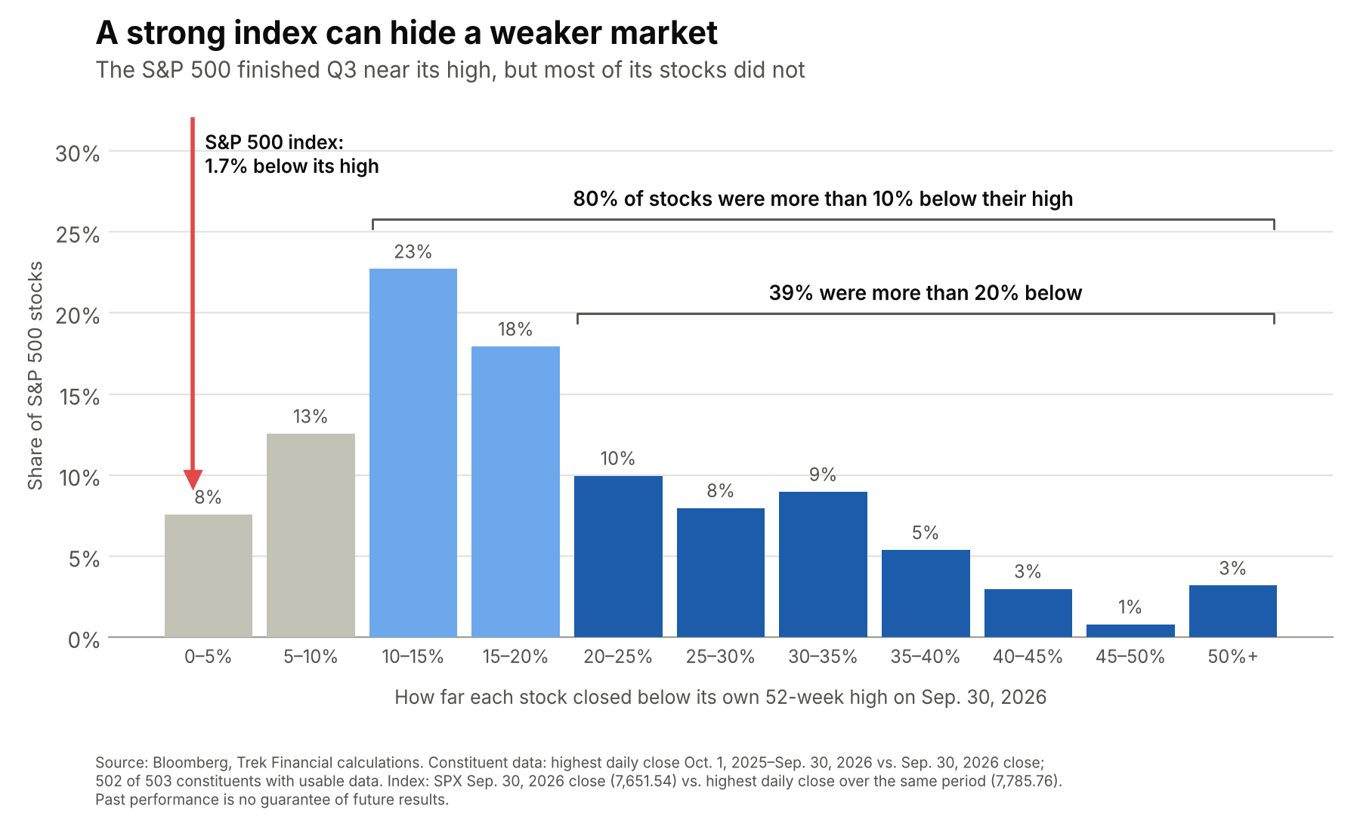
At first glance, the quarter looked resilient. The S&P 500 ended September about 2% below its highest daily close over the prior 12 months. Beneath that headline, 401 of 502 S&P 500 constituents with usable data, about 80%, were more than 10% below their own 12-month closing highs. 197 stocks, about 39%, were more than 20% below. The more-than-20% group is included in the more-than-10% group. This gap shows how an index near its high can coexist with weakness across many of its constituents.1
AI demand is real; the return still has to be earned
That narrow leadership keeps attention on the companies carrying the market. The AI questions investors are asking are practical: Is demand turning into recurring revenue? Will the spending earn an attractive return? How much will infrastructure costs weigh on margins and cash flow while companies build capacity?
Alphabet’s second-quarter results show both sides of the story. Google Cloud revenue grew 82%, while capital spending reached $44.9 billion and free cash flow was negative $5.9 billion for the quarter. The company said most capital spending supported AI infrastructure and raised its full-year capital-spending outlook. Strong demand is visible; the return on that investment will take time to assess. 2
Growth continues, but inflation still matters
The latest GDP reading available at quarter-end was for Q2: the economy grew at a 2.2% annual rate. That describes the previous quarter, not Q3. In September, the Federal Reserve raised its target range by a quarter point to 3.75%–4.00%. The combination of continued growth and a rate increase illustrates the challenge of balancing economic momentum with inflation that remains a concern. 3,4
Middle East risk reaches the fuel bill
The conflict in the Middle East became a more direct economic risk as oil flows were disrupted and fuel prices rose. The U.S. Energy Information Administration reported that Brent crude averaged $114 per barrel in September, up $23 from August, following attacks on oil infrastructure and tankers in the region. EIA forecast an average of $105 per barrel for Q4 and warned that constrained flows could keep prices volatile. That forecast depends on assumptions about supply routes and production, so it should be read as a scenario, not a certainty. 5
If higher fuel costs persist, they can squeeze household budgets and raise business costs. That would add to inflation pressure and could complicate the Federal Reserve’s decisions. How much it matters will depend on how long supply routes remain constrained and how quickly production and exports recover. 4,5,7
What we learned after quarter-end
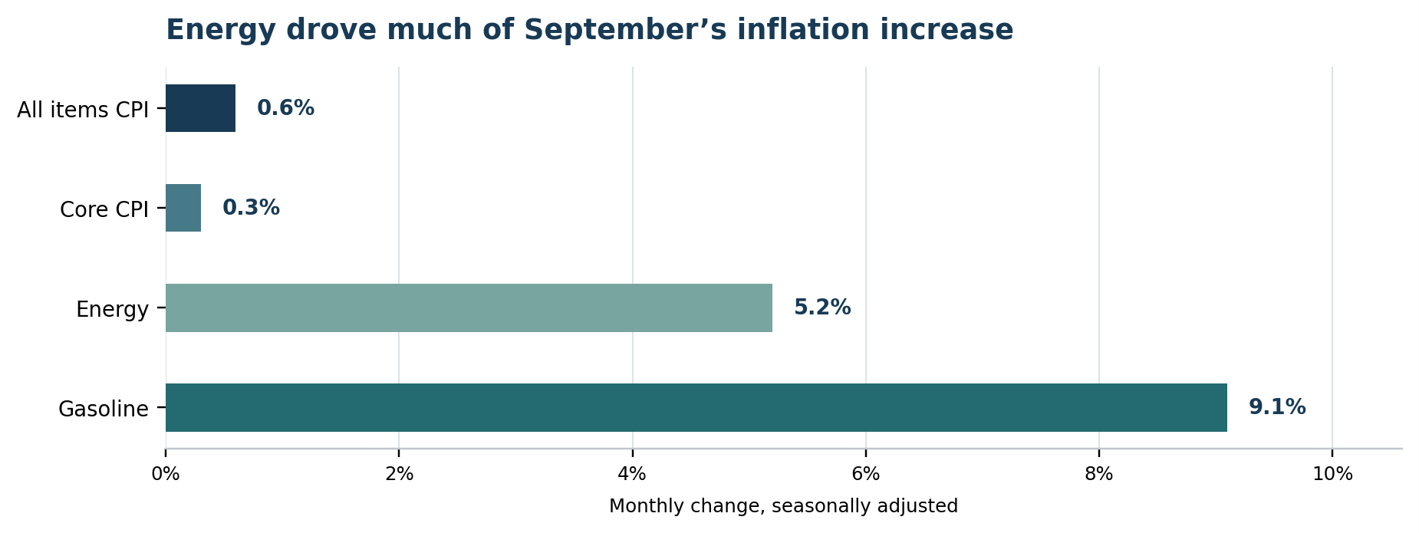
Data published in October added a mixed signal. September payrolls increased by 29,000, and unemployment was 4.2%. Consumer prices rose 0.6% in September; gasoline rose 9.1% and accounted for more than half of the monthly all-items increase. Core prices, excluding food and energy, rose 0.3% for the month and 2.6% over the year. These figures describe September, but they were released after Q3 ended. 6,7
As of October 20, the advance estimate of Q3 GDP had not been released; BEA scheduled it for October 29. 8
What We’re Watching
- Market breadth: Can more companies participate in gains, or will leadership remain concentrated?
- AI returns: Do revenue, margins, and cash flow begin to justify the scale of infrastructure spending?
- Fuel and inflation: Do supply disruptions ease, or do energy costs keep pressure on households, businesses, and inflation?
- Growth and policy: Does incoming data support continued expansion without reigniting inflation?
The quarter ended with indexes that looked stronger than the typical stock, an AI investment cycle with visible demand and rising costs, and a new source of inflation risk in energy markets. The next test is whether earnings broaden, AI spending produces lasting returns, and fuel prices stabilize enough to keep inflation from becoming a larger obstacle. 1,2,5,7
Endnotes
Numbered markers point to the source notes below. Linked source titles are clickable.
- Bloomberg Data, S&P 500 constituent and SPX Index daily PX_LAST closing prices, retrieved October 20, 2026; Trek Financial calculations. For each constituent, the September 30, 2026 close is compared with its highest daily close from October 1, 2025 through September 30, 2026. The index close (7,651.54) is compared with its highest daily close over the same period (7,785.76), a 1.7% decline, rounded to about 2%. Of 503 constituents, 502 had usable high and closing prices. Thresholds are strict. The more-than-20% group is included in the more-than-10% group. Supporting Bloomberg workbook and constituent calculations are retained in the compliance backup.
- Alphabet Investor Relations, “2026 Q2 Earnings Call,” July 22, 2026. Company transcript covering revenue, capital spending, AI infrastructure, and free cash flow.
- U.S. Bureau of Economic Analysis, “GDP (Third Estimate), Industries, Corporate Profits, State GDP, and State Personal Income, 2nd Quarter 2026,” September 30, 2026.
- Board of Governors of the Federal Reserve System, “Federal Reserve issues FOMC statement,” September 16, 2026.
- U.S. Energy Information Administration, Short-Term Energy Outlook, October 2026, “Global Oil Markets,” PDF.
- U.S. Bureau of Labor Statistics, “The Employment Situation — September 2026,” October 2, 2026. Archived release.
- U.S. Bureau of Labor Statistics, “Consumer Price Index — September 2026,” October 14, 2026. Archived release.
- U.S. Bureau of Economic Analysis, Release Schedule, 2026. Q3 GDP advance estimate scheduled for October 29, 2026.
Disclosure :
This overview presents a cautious interpretation of current economic indicators and their potential implications for investors. It’s important for investors to remember that market conditions are inherently uncertain and subject to change. The information provided here should not be considered as personalized investment advice or a prediction of future market movements. Investors are encouraged to consult with their financial advisor to discuss their individual financial situation and goals. A comprehensive investment strategy should consider the investor’s risk tolerance, investment time horizon, and any changes in economic conditions.
Investment Advisory Services offered through Trek Financial LLC, an investment adviser registered with the Securities Exchange Commission. Information presented is for educational purposes only. It should not be considered specific investment advice, does not take into consideration your specific situation, and does not intend to make an offer or solicitation for the sale or purchase of any securities or investment strategies. Investments involve risk and are not guaranteed, and past performance is no guarantee of future results. For specific tax advice on any strategy, consult with a qualified tax professional before implementing any strategy discussed herein. Trek 26-177


